Back-neck short rows calculator
Short rows raise the back neck. Enter your gauge and measurements to get the number of rows and the stitches in each.
Raglan calculator
1Gauge from your swatch
2Size and measurements
Neckline is the neck circumference plus 1.5–3 in. Make sure your head fits through. Upper arm is the widest part of the arm.
3Style
Yoke depth
Result
Back-neck short rows by size
| Size | Rows | Height | Row 1 | Row 2 | Each next row |
|---|---|---|---|---|---|
| Child 2 years (chest 21 in) | 6 rows | 0.8 in | 32 sts | 47 sts | +2 sts |
| Child 6 years (chest 24 in) | 6 rows | 0.8 in | 34 sts | 49 sts | +2 sts |
| Child 10 years (chest 28 in) | 6 rows | 0.8 in | 38 sts | 55 sts | +2 sts |
| Women's S (bust 33 in) | 8 rows | 1.1 in | 43 sts | 61 sts | +2 sts |
| Women's M (bust 37 in) | 8 rows | 1.1 in | 45 sts | 64 sts | +2 sts |
| Women's L (bust 41 in) | 8 rows | 1.1 in | 47 sts | 67 sts | +2 sts |
| Women's 1X (bust 45 in) | 8 rows | 1.1 in | 49 sts | 69 sts | +2 sts |
| Men's M (chest 40 in) | 8 rows | 1.1 in | 48 sts | 68 sts | +2 sts |
| Men's L (chest 44 in) | 8 rows | 1.1 in | 51 sts | 72 sts | +2 sts |
| Men's XL (chest 48 in) | 8 rows | 1.1 in | 54 sts | 76 sts | +2 sts |
For a gauge of 20 stitches and 28 rows per 4 in with 2-stitch raglan lines. Row 1 starts at the beginning of the back; row 2 works back to the same point on the other side. Use the calculator above for your own gauge.
Raglan calculators:
Handmade by Rukodelius makers
Browse all work →Real finished pieces from our community of knitters and crocheters.
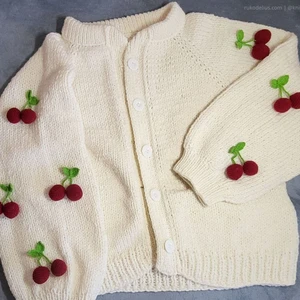 Cherry Cardigan 🍒 ★ 4.4
 Cardigan Pink Heather 🌸 ★ 4.3
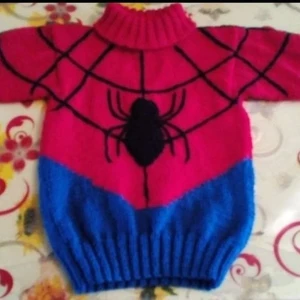 Spider-Man Sweater 🕷️ ★ 4.1
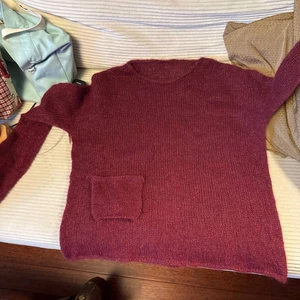 Lingonberry Jumper 🍒 ★ 4.0
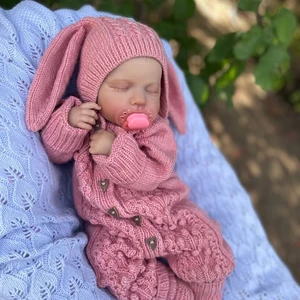 Sleepy Little Bunny 🐇 ★ 4.7
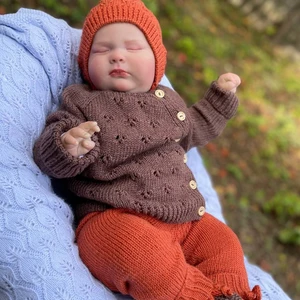 Terracotta Forest Elf 🍂 ★ 4.6
 Turquoise Young Sailor ⚓ ★ 4.6
 Little Rose in the Clouds 🌸 ★ 4.5
Frequently asked questions
How do I calculate back-neck short rows?
Multiply the height you want (1–1.5 in for adults, 0.75 in for children) by your rows per inch and round to an even number. For size M at 28 rows per 4 in that is 8 rows, about 1.1 in. The first row ends 2 stitches past the front raglan line and every following row goes 2 stitches further.
How many stitches are in each short row?
For size M at 20 stitches per 4 in: 45, 64, 66, 68, 70, 72, 74, 76. Row 1 covers the back, a raglan line, a sleeve, another line and 2 front stitches; row 2 works back to the same point on the other side.
Do I work short rows before or after the neckband?
After the ribbed neckband and before the raglan increases start. The ribbing stays even all the way round and the back rises right below it.
Which short-row method should I use?
Any of them: German short rows, wrap and turn, or yarn-over short rows. Just remember to close the double stitch or wrap when you return to working in the round.
Can I skip the short rows?
Yes, for a wide boat neck or an oversized shape. On a crew neck without them, the front rides up toward the throat and the back slides down.
More knitting tools
How the raglan calculator works
The cast-on is the neckline circumference times your stitch gauge. Each of the four raglan lines takes 1–4 stitches, and the rest is split into six parts: two for the back, two for the front and one for each sleeve.
The calculator then works out how many stitches you need at the underarm: chest plus ease for the body, and upper arm plus ease for the sleeve. That gives the number of increase rows, separately for the body and for the sleeves.
Increases are spread over the yoke depth: closer together at the top, further apart near the underarm. If the yoke is too shallow to fit them all, the last ones are worked on every row.
It works for sweaters knitted in the round and for cardigans knitted flat. The stitch math is done by code, not by an AI model, so the numbers always add up.