Knitting gauge converter
Enter the pattern gauge and your own to see how many stitches and rows to work at your gauge.
Convert a pattern to your gauge
Pattern gauge
My gauge
What to convert
Your swatch
Finished size
Pattern repeat and edge stitches
For example, 2×2 rib in the round: repeat 4, plus 0. Knitted flat: repeat 4, plus 2.
Result
Knitting gauge chart by yarn weight and needle size
| Yarn weight | Needles | Stitches per 4 in | Rows per 4 in |
|---|---|---|---|
| Lace | US 000–1 (1.5–2.25 mm) | 33–40 | 44–54 |
| Fingering / sock | US 1–3 (2.25–3.25 mm) | 27–32 | 36–44 |
| Sport | US 3–5 (3.25–3.75 mm) | 23–26 | 30–36 |
| DK | US 5–7 (3.75–4.5 mm) | 21–24 | 28–32 |
| Worsted | US 7–9 (4.5–5.5 mm) | 16–20 | 22–28 |
| Aran | US 9–10.5 (5.5–6.5 mm) | 14–16 | 19–22 |
| Bulky | US 10.5–11 (6.5–8 mm) | 12–14 | 16–19 |
| Super bulky | US 11–17 (8–12 mm) | 7–11 | 10–15 |
Typical stockinette gauge. Yours can differ by 1–3 stitches, which is normal and is why you swatch before starting.
Related:
Handmade by Rukodelius makers
Browse all work →Real finished pieces from our community of knitters and crocheters.
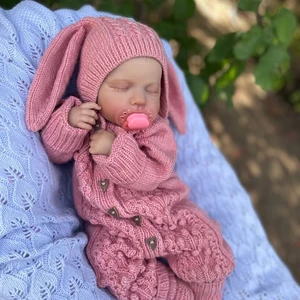 Sleepy Little Bunny 🐇 ★ 4.7
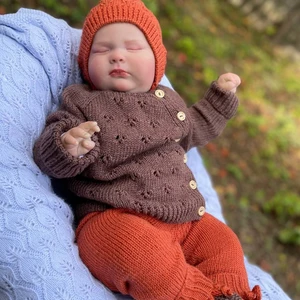 Terracotta Forest Elf 🍂 ★ 4.6
 Turquoise Young Sailor ⚓ ★ 4.6
 Little Rose in the Clouds 🌸 ★ 4.5
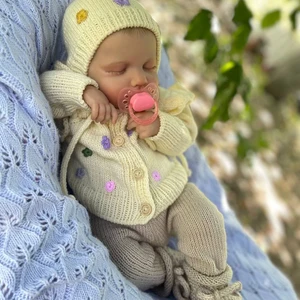 Lemon Floral Dream 🌼 ★ 4.5
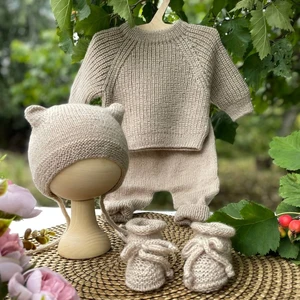 Linen Teddy Bear 🧸 ★ 4.5
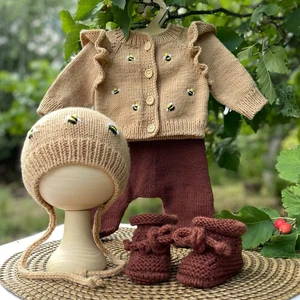 Honey Bees 🐝 ★ 4.5
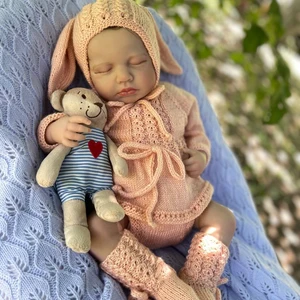 Peach Bunny 🐰 ★ 4.5
Frequently asked questions
What is knitting gauge?
Gauge is how many stitches and rows fit into 4 inches (10 cm) of fabric, written as 20 stitches × 28 rows = 4 × 4 in. It depends on the yarn, the needles, the stitch pattern and the knitter.
How do I measure my gauge?
Knit a swatch at least 5 × 5 in in the same stitch pattern and needles, then wash and dry it. Lay a ruler across the middle and count the stitches in 4 inches across and the rows in 4 inches down. Count half stitches too: 21.5 is not 21 or 22.
What if my gauge does not match the pattern?
If you get more stitches per 4 in than the pattern, go up half a needle size; if fewer, go down. If you only like the fabric on your current needles, convert the pattern to your gauge instead.
How do I convert a pattern to my gauge?
Divide your gauge by the pattern gauge and multiply by the stitch count. For example, the pattern has 22 stitches per 4 in and casts on 110, and you get 20 stitches per 4 in: 110 × 20 ÷ 22 = 100 stitches. Rows convert the same way, using the row gauge.
What gauge does fingering-weight yarn knit to?
On US 1–3 (2.25–3.25 mm) needles, usually 27–32 stitches and 36–44 rows per 4 in in stockinette. Socks are knitted tighter, at 30–34 stitches.
More knitting tools
How the gauge calculator works
Stitches = width × stitches per inch. Rows = length × rows per inch. If you enter a pattern repeat, the result is rounded to the nearest multiple of the repeat, plus the extra and edge stitches.
Everyone knits at a different gauge, so use the numbers from your own swatch, even when the pattern or the yarn label states a gauge.